
Most competitor analyses are theatre. Someone screenshots a few rivals’ accounts, logs their follower counts in a spreadsheet, notes that Brand X posts more than Brand Y, and presents it in a deck nobody opens again. It looks like work. It changes nothing.
A useful competitor analysis does something narrower and harder. It works out what is genuinely working for the brands competing for your audience’s attention, why it works, and what you can borrow or beat. The follower counts are almost beside the point.
This is the version we actually run for clients. It assumes you want decisions out the other end, not a slide. It is also worth doing alongside your wider search visibility work, since the same audience research feeds into ranking in Google AI Overviews and organic growth more broadly.
The short version
The mistake most people make is measuring the easy things: follower counts, posting frequency, total likes. None of those tell you much any more, because reach on most platforms is no longer tied to follower count. Instead, judge how far a competitor’s content travels relative to their size, work out their hit rate rather than their volume, and pay close attention to what they put money behind. Then copy what is proven before you gamble on what is untested, and turn the whole thing into a monthly habit rather than a one-off report.
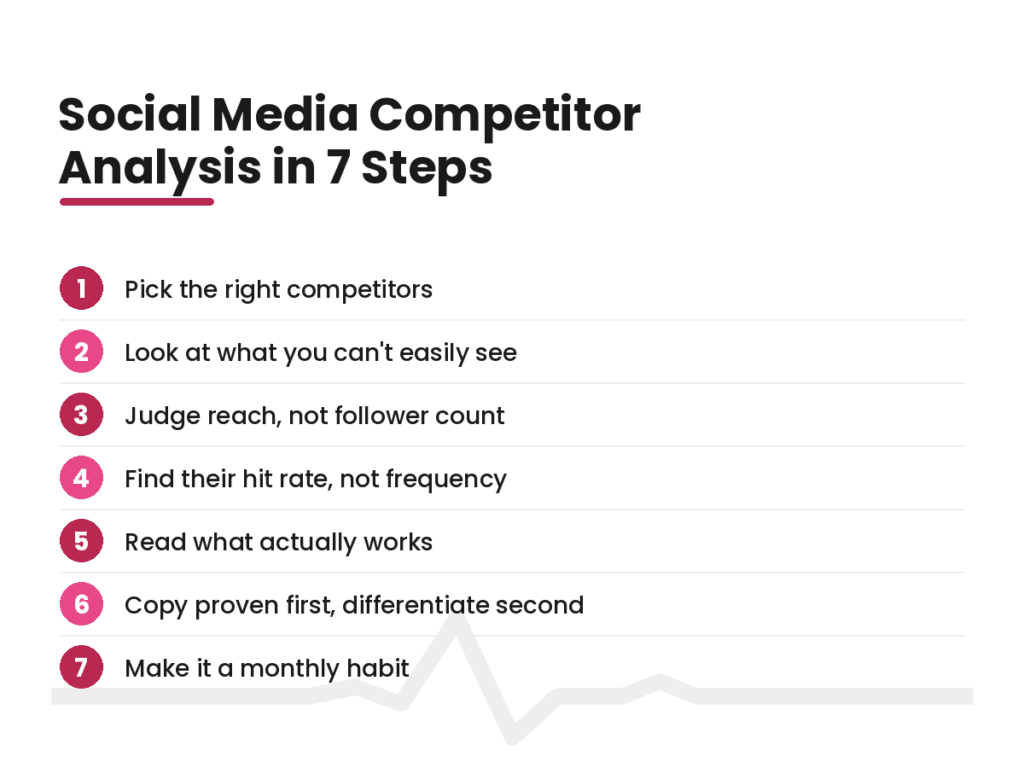
Step 1: Pick the right competitors, and avoid the aspirational trap
Three to five competitors is enough. The harder question is which ones.
The common mistake is filling the list with aspirational brands: the big names whose social everyone admires. Studying them feels productive, but their playbook rarely transfers. They have brand equity, budget and audience scale you do not, and content that works off the back of a million existing followers will not do the same for you. If you sell locally and study a national brand, you are learning the wrong lessons.
Study the brands one tier above you, not five. Close enough that their audience overlaps with yours and their resources are within reach.
It also helps to separate two different kinds of competitor. There are the brands you compete with for sales, and the brands you compete with for attention in the feed. They are not always the same. Your sales rival might be barely present on social, while the account actually winning your audience’s attention is a publisher, a creator or an adjacent brand you never think of as competition. Both belong in the analysis, for different reasons.
Step 2: Look at what you cannot easily see, not just what you can
Here is the uncomfortable part of competitor analysis: most of what matters is invisible. You cannot see a competitor’s reach, impressions, most of their saves, their click-through, or how much of their engagement was paid for rather than earned. Anyone presenting a competitor’s engagement as clean fact is guessing.
So the skill is knowing which visible signals are worth reading. The most valuable one, and the one junior analyses almost always skip, is what a competitor pays to promote.
Two free tools show you this. The Meta Ad Library lists every ad a brand is currently running across Facebook and Instagram. TikTok’s Creative Center does something similar for top-performing ads on that platform. Both are open to anyone.
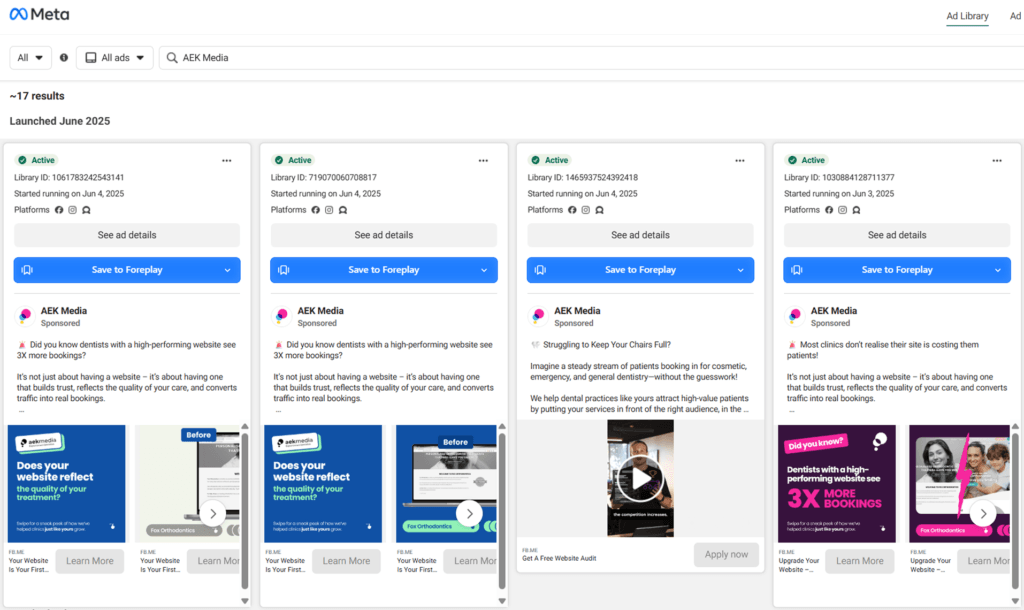
What a brand chooses to put budget behind is a far stronger signal than what gets likes, because it tells you what they believe actually converts. It is also a useful window into how competitors approach paid social more generally. Pay attention to how long an ad has been running. One that has been live for months is a winner they will not switch off. A hook they reuse across several ads is one they have tested and trust. You are reading their conclusions without having to run their experiments.
Step 3: Judge reach and distribution, not follower count
Follower count is close to a vanity metric now, and building an analysis around it is the most common way to reach the wrong conclusions.
On Instagram, TikTok and increasingly everywhere else, content is distributed mainly to people who do not follow the account. A competitor’s follower number tells you how big they got, not how far their content currently travels. Those are different things, and the second one is what you care about.
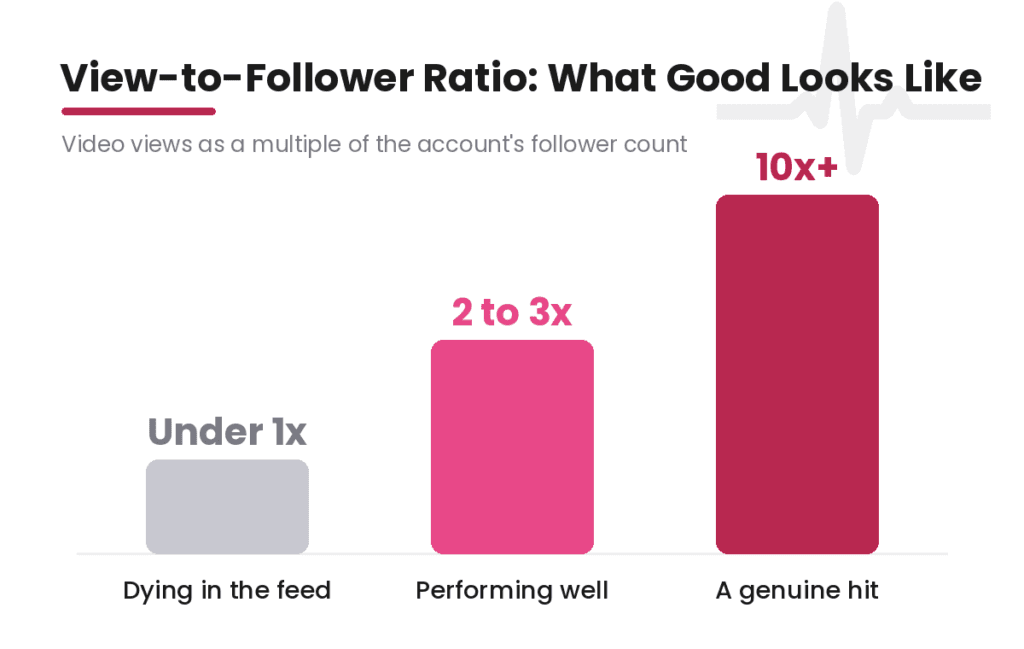
The better measure is reach relative to size. You can approximate it with the ratio of views to followers on video content:
- A video pulling two to three times the follower count in views is performing well and reaching beyond the existing audience.
- Ten times or more is a genuine hit.
- Well under the follower count means the content is dying in the feed, however large the account.
This is also why you cannot compare engagement rates across accounts of very different sizes. Small accounts routinely post engagement rates a large brand could never match, simply because of how the maths works. A micro-brand sitting at five per cent and a national brand sitting at one per cent may both be doing fine. Comparing the two tells you nothing.
Step 4: Find their hit rate, not their posting frequency
Posting frequency is another number that looks meaningful and mostly is not. Matching a competitor’s cadence is one of the fastest ways to burn budget producing forgettable content.
What matters is their hit rate: the proportion of posts that actually land. A competitor posting daily where one post in twenty performs is telling you their format works occasionally and they are leaning on volume. A competitor posting twice a week where nearly every post performs is telling you something far more useful about what resonates.
To find the hit rate, do not log everything. Log the outliers. Each month, capture a competitor’s top three posts by visible engagement and ignore the rest. Patterns live in the outliers, not the averages. Ten minutes per competitor per month is enough, and it keeps the analysis something you will actually repeat.
Reading the signals is one thing. Turning them into an organic social presence that pulls ahead of your competitors is another, and it is the part we enjoy most. If you would like a hand with that, our Organic Social team runs this process for brands every day.
Email: hello@wearebrandamp.com Phone: +353 86 1655 249
Step 5: Read their content for what works, not what they want to work
Once you have the outliers, read them properly. There is usually a gap between the content a brand wants to be known for and the content that actually works for it.
The content they want to be known for is easy to spot. It is pinned, it is in the bio, it is the polished brand film. The content that works is in the top organic posts you just pulled. When those two disagree, and they often do, the top posts are the truth.
Keep a running swipe file of the competitor posts that performed, and tag each one with why you think it worked: the hook, the format, the topic, the offer. Over a few months this becomes the single most useful document your content team has, because it is a library of proven ideas from brands your audience already responds to.
Step 6: Decide where to copy and where to differentiate
Now the part most advice gets backwards. The standard instruction is to find the gaps, the things no competitor is doing, and fill them. In practice, a gap is usually a gap for a reason.
If nobody in your space is on a given platform, the likeliest explanation is that the audience is not there or it does not convert, not that everyone missed an opportunity. Empty space is empty more often because it is barren than because it is untouched.
So invert the usual order. Copy what is proven first. If a format or topic is working across several of your competitors, that is a validated bet, and doing it better than they do is the highest-return move available to you. Save the genuinely novel, nobody-is-doing-this ideas for once you have exhausted the proven ground. Whitespace is where you go after you have earned the right to experiment, not before.
Step 7: Make it a monthly habit, not a one-off deck
A competitor analysis presented once and filed away is the theatre we started with. The version that changes results is small, regular and pointed at action.
Keep it to a monthly loop. Each month, refresh the outliers and the ad library check, add anything new to the swipe file, and pull out one or two things worth testing on your own accounts. That is the entire output: not a verdict on who is winning, but a short list of proven ideas to try next.
Do that consistently and the compounding advantage is real. You are effectively running experiments using your competitors’ budgets, keeping what works for them and skipping what does not.
Frequently asked questions
It depends heavily on account size, which is why raw comparison is misleading. As a rough guide, smaller accounts under about ten thousand followers often sustain engagement rates of three to six per cent, while large brand accounts frequently sit between half a per cent and one and a half per cent and are performing perfectly well. Judge a competitor against others of a similar size, not against your own account if yours is much bigger or smaller.
Sixty to ninety days is usually enough to see current patterns without drowning in history. Going back further mostly captures strategies the brand has already abandoned, which tells you where they used to be rather than where they are heading. The one exception is seasonal patterns, where a look at the same period last year can be worth the effort.
This is more common than people admit, and it is a trap. If your only benchmark is a set of mediocre competitors, then better than them is a low bar that leaves you exposed the moment a sharper entrant arrives. When your direct competitors are weak, set your benchmark externally: study brands outside your category who genuinely own the format or platform you care about, and hold yourself to that standard instead. It is also worth widening the lens beyond social, since the same competitors are often winning ground through SEO and organic search too.
For most brands, no. The manual process here, plus the free ad libraries, covers what you need. A paid tool earns its place in two situations: when you need to track share of voice or growth trends across many competitors over time, or when you are monitoring more competitors than you can reasonably check by hand. Start manual, and only pay once you know the specific thing you are missing.
Ready to get ahead on social?
A competitor analysis shows you what is already working in your market. Acting on it consistently, month after month, is where the growth actually happens, and that is the part we love.
If you would like Brand Amp to help you build and run an organic social presence that outperforms your competitors, we would be glad to talk it through.
Email: hello@wearebrandamp.com Phone: +353 86 1655 249