

Discover 7 proven strategies to rank in Google AI Overviews, capture zero-click search visibility, and optimise your brand for conversational generative search models. Implement actionable answer engine tactics today.
The mechanics of search engine discovery are undergoing a fundamental shift. Google AI Overviews now appear at the top of organic search results for millions of complex queries, synthesising direct answers from across the web before a user clicks a single traditional link.
For brands reliant on organic search, this evolution presents both a challenge and an opportunity. While traditional organic rankings remain essential, winning inclusion within AI Overviews requires Answer Engine Optimisation (AEO). You must format, structure, and position your digital assets so that search engine Large Language Models (LLMs) parse your content as the definitive, primary source.
Below are 7 strategies to help you earn citations in Google AI Overviews, capture high-intent visibility, and future-proof your organic search strategy.
1. Target Long-Tail Informational Queries and Semantic Context
Google AI Overviews rarely trigger for simple, single-keyword searches. Instead, they activate for multi-part, nuanced informational questions where users seek a synthesized explanation.
To process these complex requests, search algorithms use query expansion techniques (often referred to as query fan-out). The system breaks a user query into multiple sub-questions, searching the web for semantically relevant passages across related intents. Ranking requires answering the broader topic and addressing all logical follow-up questions within a single, cohesive asset.
Action Plan:
- Identify complex, multi-word queries using intent research tools, focusing on specific “how”, “why”, and “can you” questions relevant to your industry.
- Group related informational queries into comprehensive content hubs rather than creating fragmented, single-question pages.
- Address implicit follow-up questions directly within subheadings to cover the full semantic spectrum of the topic.
Key Takeaway: AI Overviews reward semantic depth over superficial keyword placement. Structuring content around complete topic clusters ensures search crawlers identify your page as a comprehensive resource for multi-part queries.
2. Structure Content in Self-Contained, Extractable Passages
Search engine algorithms evaluate web pages in discrete chunks rather than as monolithic blocks of text. When an AI Overview generates a response, it extracts specific passages from multiple sources to construct its answer.
If your content relies on vague introductions, buried key points, or rambling explanations, language models will pass over your text in favour of clearer, better-structured alternatives. Every major section must be able to stand on its own as an independent answer.
Action Plan:
- Format primary headings (H2 and H3) as direct questions or clear declarative statements every 150 to 200 words.
- Write a concise summary paragraph (25 to 45 words) immediately beneath each heading that provides a direct answer before diving into deeper nuances.
- Use clean HTML structures, including ordered lists, bullet points, and comparative tables, to make key data points immediately extractable for automated crawlers.
Key Takeaway: Passages that provide immediate, direct answers beneath descriptive headings are vastly easier for language models to parse, extract, and cite as source material in AI Overviews.
Need Help Optimising Your AI Search Visibility?
Capturing citations in Google AI Overviews requires a combination of technical schema markup, passage-level content engineering, and digital authority. If you want to audit your current search footprint or prepare your site for generative search, contact the Brand Amp technical team at hello@wearebrandamp.com or call us on +353 86 1655 249 to schedule a strategy session.
3. Deploy Entity-Based Schema Markup
Structured data code acts as an explicit translation layer between your website and search engine crawlers. While LLMs excel at parsing natural text, implementing schema markup confirms the exact real-world context of your information without room for misinterpretation.
By defining data entities such as organisations, authors, products, FAQs, and step-by-step processes, you give search engines structured verification of your page content.
Action Plan:
- Implement FAQPage schema on informational assets containing clear question-and-answer pairs.
- Embed Article and Organization JSON-LD schema to explicitly link your content to verified author credentials and brand entities.
- Validate all schema code using Google’s Rich Results Test to resolve syntax errors or missing required properties.
Key Takeaway: Schema markup removes ambiguity for search crawlers. Clearly defining your page entities increases the probability that algorithms will trust and cite your data in AI-generated answers.
4. Ground Statements in Original Research and Explicit Citations
Generative AI search models are designed to minimise hallucination by prioritizing content that demonstrates high levels of credibility, factual accuracy, and expert commentary.
Pages that simply rehash existing top-10 search results offer little value to an AI model building a summary. To earn a citation, your content must provide original data, proprietary research, or expert insights supported by authoritative external references.
Action Plan:
- Publish original survey data, proprietary case studies, or unique industry benchmarks that other platforms cannot replicate.
- Incorporate direct quotes and verified perspectives from recognized subject matter experts within your organisation.
- Cite reputable external sources (such as academic institutions, government bodies, or primary industry studies) using clear anchor text and outgoing links.
Key Takeaway: Citing authoritative primary sources while providing unique first-party data signals to Google that your content is a credible anchor point for AI summaries.
5. Ensure Technical Crawlability and Eliminate Rendering Blockers
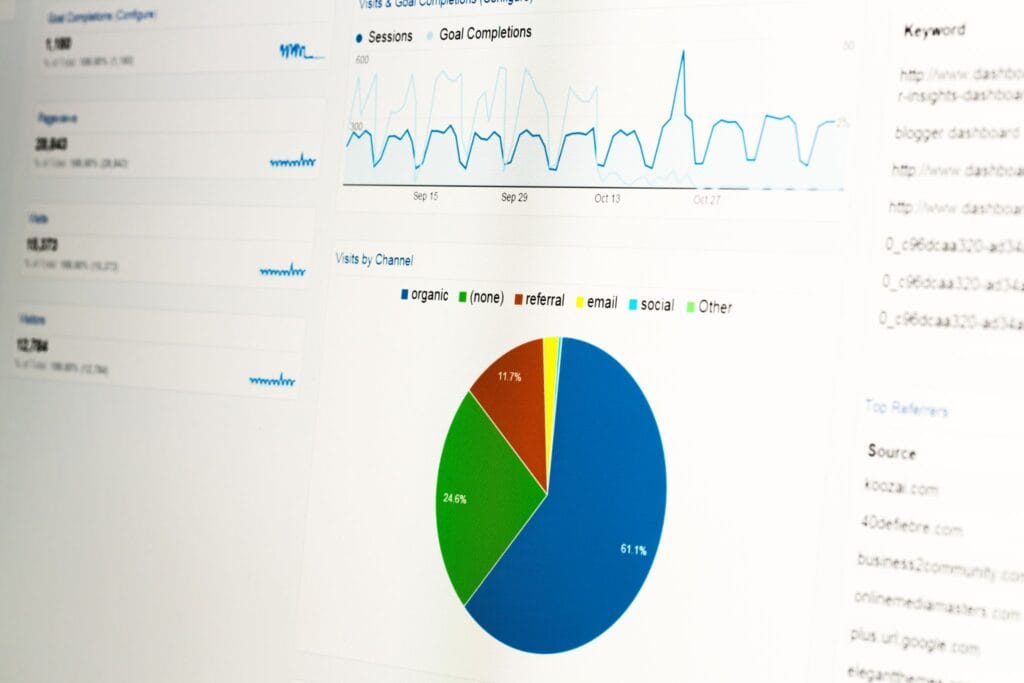
An AI model cannot summarize or cite content that search engine crawlers struggle to access. Technical performance and clean architecture remain prerequisites for generative search visibility.
If critical text is hidden behind complex JavaScript rendering, buried inside unindexed PDF files, or blocked by improper directives, your content will be excluded from AI Overviews regardless of its editorial quality.
Action Plan:
- Audit your robots.txt file and meta tags to ensure search bots are not accidentally blocked from crawling core informational pages.
- Ensure primary body copy renders server-side or via HTML rather than relying solely on client-side JavaScript execution.
- Maintain a clean internal link structure and resolve 404 errors, redirect chains, or slow server response times that waste crawl budget.
Key Takeaway: A flawless technical foundation ensures search engine bots can efficiently crawl, render, and index your content passages for real-time AI retrieval.
6. Systematic Content Refreshing to Maintain Freshness
Data freshness is a critical factor in AI Overview selection. Google regularly prioritizes recent, up-to-date information when constructing answers for fast-moving topics, industry regulations, or evolving trends.
Furthermore, empirical search studies indicate that roughly two-thirds of the sources cited in AI Overviews already rank on the first page of traditional Google search results. Updating your existing top-performing content is often the fastest route to securing AI citations.
Action Plan:
- Review high-performing informational pages every six months to update outdated statistics, references, and external links.
- Expand historical posts by adding dedicated sections for emerging sub-topics and recent industry developments.
- Update the visible Last Modified date tag on your site only after making substantial, meaningful editorial revisions.
Key Takeaway: Protecting your existing top-10 organic positions while regularly refreshing outdated statistics dramatically improves your odds of being cited in AI Overviews.
7. Build Off-Site Brand Authority and Third-Party Mentions
AI search models do not evaluate your website in isolation. They crawl the broader web to gauge whether your brand is routinely recognized as an authority across external publications, industry forums, news outlets, and digital communities.
Unlinked brand mentions, editorial citations, and digital PR placements all contribute to your entity authority score, signaling to LLMs that your brand is a trusted reference point in your niche.
Action Plan:
- Execute data-driven digital PR campaigns to secure coverage and contextual editorial mentions in tier-one industry publications.
- Participate in expert roundups, guest commentary opportunities, and industry podcasts to build brand entity associations.
- Monitor third-party discussion platforms and industry hubs to ensure your brand is accurately referenced across external digital channels.
Key Takeaway: Off-site authority validates on-site content. The more frequently your brand is cited across trusted external publications, the more confident AI models become in featuring your insights.
How to Measure Your Performance in AI Overviews
Tracking performance in generative search requires monitoring both traditional search analytics and specialised visibility metrics.
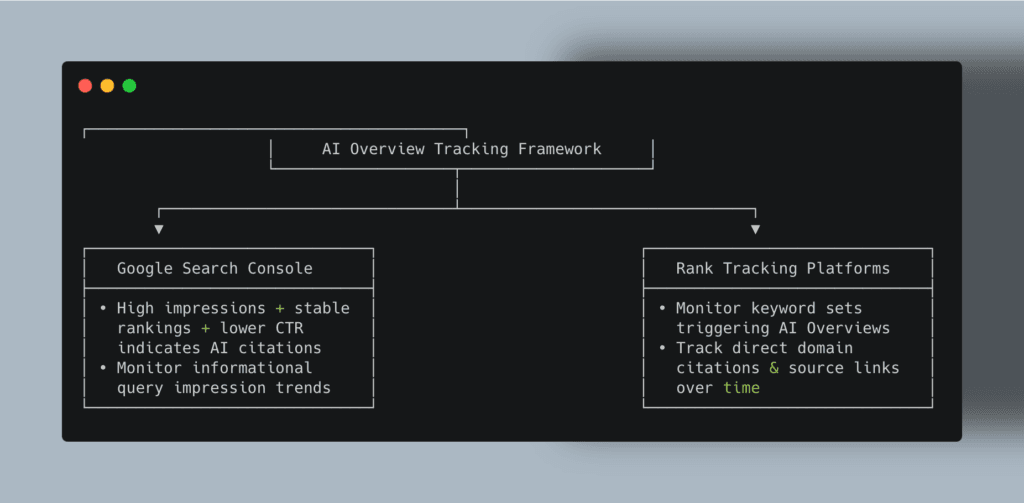
Monitor Impressions vs. Clicks in Google Search Console: An increase in impressions paired with stable rankings but a slight reduction in Click-Through Rate (CTR) often indicates that your content is being featured in zero-click AI Overviews. Users receive your answer directly on the search page, increasing brand exposure.
Track Domain Citations in Search Tracking Tools: Use specialized rank tracking suites to filter your target keyword list specifically for SERP features containing AI Overviews. Track whether your domain is actively cited in the expandable source cards.
Executive Summary & Next Steps
Ranking in Google AI Overviews is not about abandoning traditional Search Engine Optimisation. Instead, it represents the natural evolution of SEO toward Answer Engine Optimisation. By combining semantic topic coverage, extractable passage formatting, entity schema, and off-site PR authority, you build an organic presence that satisfies both human readers and search algorithms.
Executing a generative search strategy requires dedicated technical expertise, structured content engineering, and consistent media outreach.
If you are ready to scale your organic search footprint, optimize for generative AI engines, or elevate your digital PR efforts, partner with the specialists at Brand Amp.
- Email Us: hello@wearebrandamp.com
- Call Us: +353 86 1655 249