How to Run Christmas Ads in Ireland for Your Ecommerce Store (Even If You Never Advertise the Rest of the Year)
Most Irish ecommerce stores treat Christmas ads as a gamble. They switch campaigns on the week of Black Friday, pay the highest ad costs of the year, then switch everything off in January and wonder where the money went.
In our experience, the stores that do well at Christmas aren’t usually the biggest spenders. They start earlier, their tracking works, and they know which customers to go after in each week of the season. If you only advertise once a year, this is the window that justifies it. Below, we’ve pulled together what Irish shoppers spent last Christmas and how we’d plan a campaign around it.
The short version
The best time to run Christmas ads in Ireland is now. Ad costs stay low until early November, then climb sharply as every shop rushes in before Black Friday. So start in the first week of November, use the cheap weeks to get people used to seeing your brand, and spend the most on Black Friday, Cyber Monday and the last few days before Christmas.
What Irish shoppers spend between now and Christmas
The figures below come from last Christmas, the most recent full season on record. Taken together, they show a lot of money, a growing share of it spent online, and spending that peaks on the same few days each year.
The size of the season
Retail Ireland forecast that the average household would spend €1,600 on Christmas in 2025, on top of everyday expenses, with more than €9 billion extra flowing into the economy in December.
AIB customers alone made 80 million card transactions in December 2024, spending €3.9 billion, up 9% on the year before.
Bank of Ireland card spending rose 5.7% in December 2025, ahead of inflation.
Households with children expected to spend €1,601 on Christmas, against €995 for households without, according to the CCPC.
The shift online
On Black Friday 2024, AIB customers made 1.05 million online transactions worth €120 million in a single day, the bank’s biggest online spending day on record. Total online spend was up 22% on the previous Black Friday, and the average purchase rose from €103 to €114.
Bank of Ireland recorded more than 1.1 million ecommerce card transactions on 28 November 2025, another single-day record.
PwC found that 64% of Irish Black Friday purchases were planned online, and 83% of shoppers use the sales to buy a significant share of their Christmas gifts.
Shoppers aged 18 to 34 spent 61% of their money online in December 2024, compared with 42% for those aged 45 and over (AIB).
In the second half of the year, Bank of Ireland customers spend noticeably more online on electrical goods (+39%), cosmetics (+34%) and clothing (+22%) than in the first half.
The catch: shoppers are careful
Irish consumers are being careful with their money. KPMG found that two in five planned to spend less last Christmas, and EY found that seven in ten intended to do most of their festive shopping in store. Retail Ireland also noted a growing number of shoppers doing considerable research before they buy. None of that argues against online ads. Most people research online before they buy, so the online slice of Christmas spending is both large and winnable, and the brands that show up in the feed in early November are the ones shoppers recognise and trust when they come to spend. Showing up early is what your Christmas ads are for.
How to run Christmas ads in Ireland in 8 steps
1
Launch before 10 November
Starting late is the most expensive mistake we see. Meta sells its advertising space like an auction: lots of businesses bidding to appear in front of the same people. In November, nearly every shop in the country piles in at once, so the price of getting seen shoots up.
The numbers show it clearly. One large study tracked what it cost brands to put their ad in front of 1,000 people (the trade calls this the CPM). That cost barely moved until early November, then it jumped the week of 10 November: 27% higher a week before Black Friday, 84% higher on Black Friday itself, and still a fifth above normal in early December.
There is a second reason to start early. When you switch on a new campaign, Meta spends the first few days working out who is most likely to buy, and results are jumpy until it does. Begin in the first week of November and that settling-in period is behind you before the expensive weeks arrive.
If you have never advertised before, or you switched everything off after last Christmas, start earlier still. A brand-new account gives Meta nothing to go on: no record of who bought last time, no list of past visitors to win back. It needs more time, and a little more budget, to learn who your buyers are. Give it two to three weeks before Black Friday so it is not still figuring that out on your most expensive days.
2
Fix your tracking before you spend a euro
Meta can only find you more buyers if it can see who is already buying from you. Before you launch, check three things:
- The Meta Pixel is switched on and recording sales. The Pixel is a small piece of code on your website that tells Meta what visitors do, including when they buy and how much they spend.
- Those sales roughly match the orders you see in your Shopify or WooCommerce admin for the same days. If Meta is under-counting, it is working half-blind.
- Your product catalogue is connected, so Meta can show people the exact items they looked at. These automatic product ads are among the best performers at Christmas.
Since Apple changed its privacy settings, the Pixel on its own now misses a chunk of sales, because it depends on the shopper’s web browser. There is a second method, called the Conversions API, that sends the same information straight from your website’s server, which Apple’s change does not block. With both switched on, Meta sees far more of what is really happening and spends your money more accurately. If none of this is familiar, our data measurement and tracking team can set it up and check it for you in a few days.
3
Set your budget from your margin, not a round number
A lot of shops pick a Christmas budget by gut feel. There is a simple sum that works better. It tells you the point where your ads start making money instead of losing it.
Work out the profit margin on what you sell, then divide 1 by it. If half of each sale is profit (a 50% margin), you need €2 in sales for every €1 of ads just to break even. If your margin is 40%, you need €2.50. The trade calls this your break-even ROAS, which only means return on ad spend. Once your ads beat that number, every extra euro of sales above it is profit.
Then work backwards from your typical order. If a customer usually spends €50 and you can afford to pay €15 to win that sale, a €1,500 budget should bring in roughly 100 orders. Just remember that sales cost more to win in the last two weeks of November, so leave room for that from the start.
4
Let Meta’s AI do the heavy lifting
For most shops at Christmas, the simplest setup is also the best. Meta has an automated campaign type called Advantage+ (you will see that name when you set one up). Instead of you choosing exactly who sees your ads, Meta’s system tries them across a wide group of people and quickly leans into whoever is buying.
In a fast-moving period like Christmas, that speed usually beats picking audiences by hand, because the system reacts to what is working faster than a person can. We run Advantage+ as the main campaign for most of our ecommerce clients over the season.
It is not the answer to everything. Keep one separate campaign that you control by hand for the people who already know you (more on them in the next step) and for moments you need a firm grip, like pushing a single offer or protecting a tight budget. A strong Christmas setup is usually Advantage+ doing the heavy lifting, with one hand-controlled campaign running alongside it.
5
Build an audience of people who know you
The people who buy from you on Black Friday are usually people who already knew you beforehand. Use the cheaper weeks of early November to get in front of as many likely customers as you can, so you are a familiar name by the time they are ready to spend.
- Show short videos or scrolling picture ads that introduce your products and why they make good gifts. The aim here is simply to be seen by lots of new people while it is still cheap.
- Collect emails and phone numbers by offering early access to your Black Friday deals. Contacting these people again later costs you nothing.
- Quietly build lists of people to reach again: anyone who watched your videos, visited your site, or has bought from you before.
There are really two jobs here, and the balance between them changes as the season goes on. Early in November, aim to spend about 70% reaching brand-new people and 30% reminding those who already know you. By Black Friday week, tip that the other way, because people who already know you are far cheaper to turn into buyers than strangers at peak prices. For those reminder lists, we usually go back 180 days for website visitors and 365 days for past customers. Our guide to using AI in Facebook ads explains how Meta finds these people for you.
6
Plan your offer around Black Friday and Cyber Monday
Black Friday falls on 27 November 2026, with Cyber Monday on 30 November. Stores that have their offer and their ads ready well in advance tend to get the most out of them.
AIB’s data shows the shape of the peak. On Black Friday 2024, the busiest hour for online spending was 10am to 11am, with 19 transactions every second. Black Friday was the top online day of the year for clothing, jewellery, hardware and department stores, while Cyber Monday took the lead for electrical goods. Have your ads, emails and site banners live the evening before, not at 9am on the day.
On the offer itself, PwC found that 50% off is the discount threshold Irish shoppers find most attractive. If your margins can’t support that, don’t force it. Bundles, gifts with purchase, free delivery or early access for subscribers can perform just as well without eating into the profit you worked out in step 3.
What this looks like in practice
An Irish heritage apparel brand we manage ran a single Meta sales campaign from 1 to 25 December 2025.
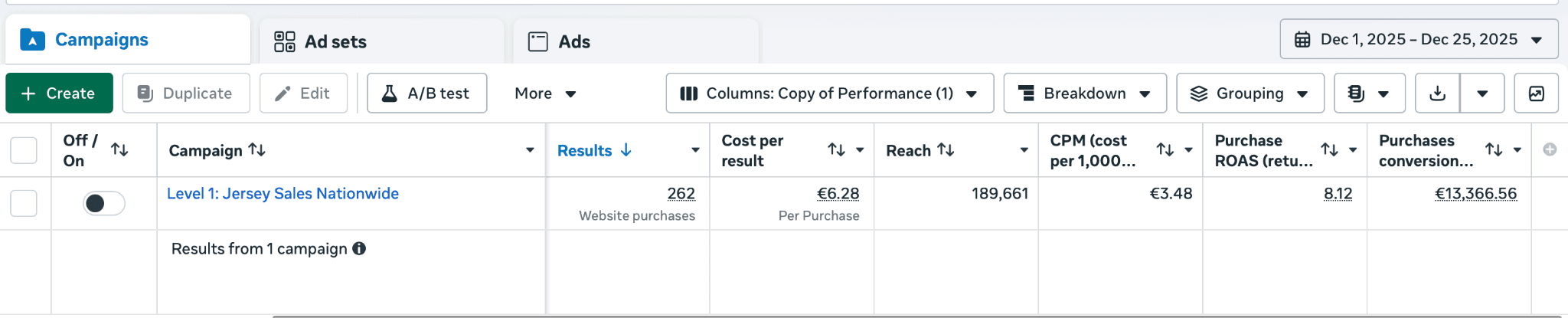
€1,646
in ad spend
262
purchases
€6.28
each
€13,366
in Meta-reported revenue
In short: €1,646 in ad spend, 262 purchases at €6.28 each, and €13,366 in Meta-reported revenue.
Every €1 spent on ads returned about €8 in sales. Christmas is the most competitive period of the year, but Irish audiences on Meta can still be affordable to reach when your tracking, your ads and the people you show them to are set up properly. Results vary by product, margin and market, so treat this as an example of what is possible rather than a benchmark.
Want results like these for your store? Leave your details and one of our paid ads specialists will call you back with a Christmas plan. It takes less than a minute.
7
Push hard into the last shipping days, then switch to gift cards
Irish shoppers leave a lot to the last minute. Retail Ireland found that more than a third of adults wait until December to make their main Christmas purchases. AIB’s busiest in store day of 2024 was 23 December, when its customers spent €114 million.
Use that urgency in your ads:
- Check your courier’s final delivery date for Christmas and build countdown messaging around it.
- Spend more on reminding people who looked at your products, or started a basket but did not check out.
- Once the delivery cut-off passes, switch your ads to digital gift cards. The CCPC found that 63% of people received at least one gift voucher last Christmas, so it’s a gift Irish shoppers are used to giving.
8
Keep going into January
Ad costs usually ease in the last week of December as other advertisers pull back, and January brings sales shoppers, gift card holders and people spending their Christmas money.
Go back to your Christmas customers with products that go well with what they already bought, and invite gift-card recipients to come and spend them. A customer who bought once in December is far cheaper to win back in January than a new one. And if the campaign made money, it’s worth asking whether you want to switch it off at all.
Frequently asked questions
Is it too late to start Christmas ads in late November?
No, but expect to pay more for each sale. If you are starting after mid-November, put most of your budget into reaching people who already visited your site, bought before, or are on your email list, rather than cold strangers. They are far more likely to buy, which makes up for them costing more to reach so late.
Should I use Meta ads or Google ads at Christmas?
They do different jobs. Meta ads create demand by putting your products in front of people who were not searching for them, which suits gifts and impulse buys. Google Shopping and Search ads capture people already searching for a product like yours. Most ecommerce stores benefit from both, with Meta doing more of the work in November and Google picking up search demand in December. Read more about our paid social and paid search services.
Can I run Christmas ads without big discounts?
Yes. Discounts are the easiest offer to run, but there are others. Gift guides, bundles, free gift wrapping, guaranteed delivery dates and limited Christmas editions all give shoppers a reason to buy now. If your product makes a good present, your Christmas ads can lead with that rather than with a percentage off.
How do I know if my Christmas ads actually worked?
Don’t rely on Meta’s own dashboard alone. It reports the sales it believes its ads influenced, and that number can be generous. The firmer test: compare your total shop takings over the campaign with the same weeks last year, then divide the extra by what you spent on ads. If that beats the break-even number from step 3, the ads paid for themselves.
Getting started
Irish shoppers will spend billions between now and Christmas, and a bigger share of it goes online every year. Whether your store gets its share depends less on the size of your budget than on when you start, how well you track and how clearly you plan each week of the season. If you only run ads once a year, this is the time to do it, and the earlier you start, the better.
Request a callback
Tell us a little about your store and one of our paid ads specialists will call you back to talk through a Christmas plan. No obligation and no hard sell.
Get in touch
Prefer to talk now? Email us at hello@wearebrandamp.com or call +353 86 1655 249.