Limerick Jazz Festival: Driving Ticket Sales Through Artist-Led Video and a Three-Level Meta Funnel
How a €680 Meta campaign generated 437 ticket checkouts in 17 days.
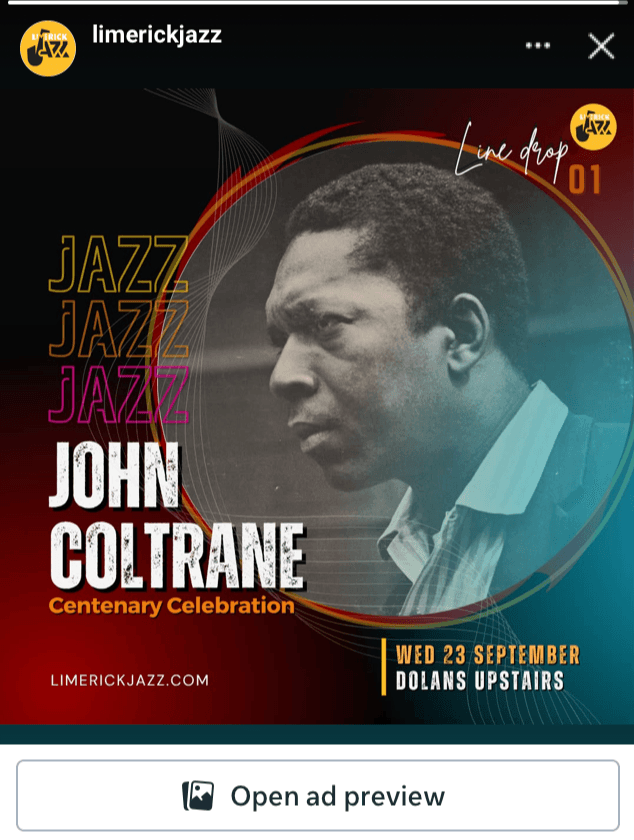
Limerick Jazz Festival is a five-day celebration of jazz and improvised music, held across venues in Limerick from 23 to 27 September 2026. Returning to BrandAmp after the 2025 campaign, the festival wanted its 2026 Meta advertising to build on the previous campaign: reach more of the right people, send them to the ticketing page and do it more efficiently.
The objective
Drive as many people as possible to start buying tickets online, while introducing local audiences to the artists on the programme. With a modest budget and a short window before the festival, every euro needed to work harder than the year before.
Our approach
We built the campaign as a three-level funnel, with each level feeding the next.
Level 0:
Engagement through video plays. An engagement campaign optimised for video plays ran every video supplied by the festival to people within 40 miles of Limerick, from a Miles Davis centenary celebration to rising talent on the local stage. Rather than using one generic message, we tailored the ad copy to each video and the audience most likely to respond to it.
Level 1:
Ticket sales to new audiences. A sales campaign optimised for checkouts reached adults within 40 miles of Limerick, guided by interests in jazz, folk, concerts and live music. Each artist on the programme had their own ad with tailored copy, alongside festival-wide ads, and the budget was split evenly between static images and video so we could compare the two formats directly.
Level 2:
Retargeting warm audiences. Once the first two levels had built up enough warm audiences, we launched a smaller retargeting campaign on 16 September. It followed up with website visitors, people who had started a checkout without finishing, video viewers and people who had engaged with the festival’s ads or social pages, again splitting the budget between images and video.
The structure kept most of the budget on sales, while the engagement level built a pool of engaged viewers that retargeting could convert at low cost.
The results
Between 9 and 25 September 2026, the campaign delivered:
initiated checkouts, more than double the 210 recorded across the whole 2025 campaign
average cost per checkout, down from €2.54 in 2025
landing page views, up 72% on 2025
impressions
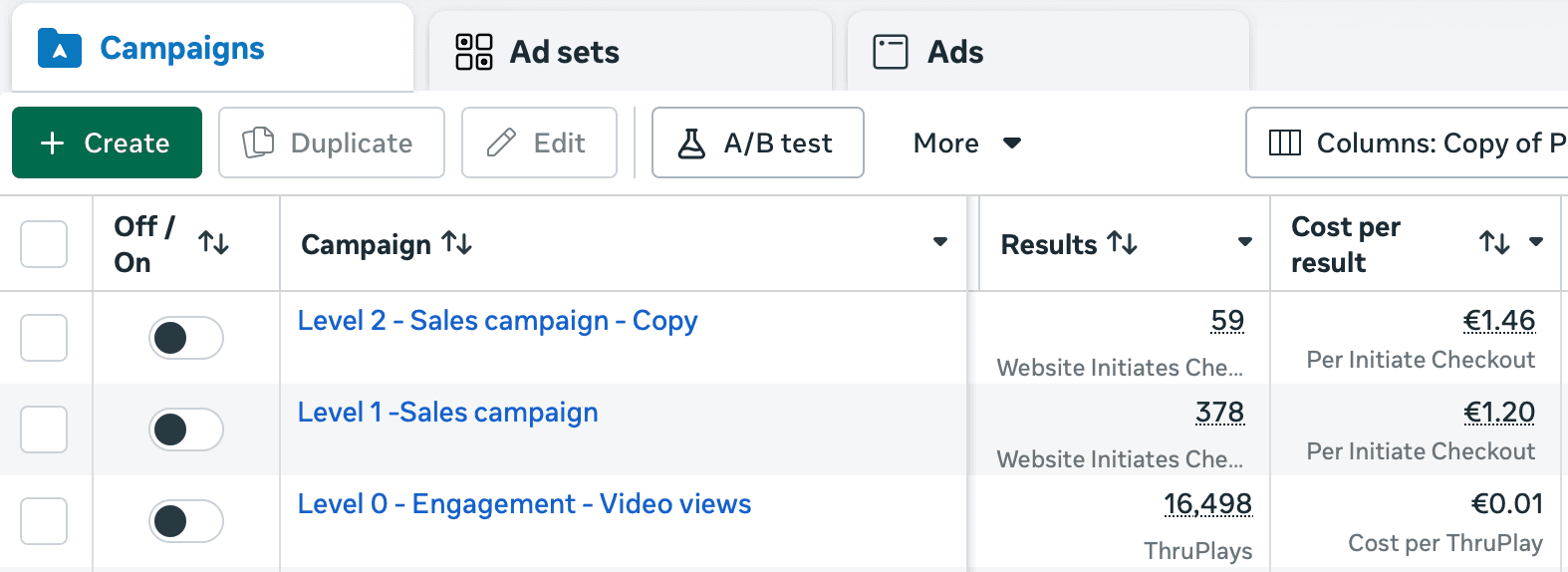
The campaign achieved this in 17 days, compared with 30 days in 2025. Total ad spend was €679.15, an increase of 27% on the previous year, while checkout volume grew by 108%. The cold audience campaign delivered 378 checkouts at €1.20 each, and retargeting added a further 59 checkouts at €1.46 each.
Planning your next event? Get in touch with BrandAmp to fill more seats.
Images and video: two formats, two jobs
Running images and video side by side, with equal budgets, showed that each format played a different role.
Video drove traffic. In the cold audience campaign, video ads generated 1,444 landing page views, more than twice the 623 from image ads, for almost identical spend.
Images converted visits. Around 29% of image ad visitors started a checkout, compared with around 14% from video, suggesting image ads attracted people who had already decided to buy.
The result was close. Video delivered 195 checkouts at €1.16 and images 182 checkouts at €1.24. In retargeting, video again edged ahead with 32 checkouts at €1.44, against 27 at €1.48 for images.
Because neither format clearly outperformed the other, keeping both running gave the campaign the reach of video and the buying intent of images, rather than relying on a single creative style.
Creative: festival-wide reach, artist-led interest
We gave every act on the programme its own ad, from Tom Ollendorff and Zoe Gilby to Tommy Halferty and Shadowlands, with copy written for that performer, alongside festival-wide ads promoting the event as a whole. Meta then distributed the budget towards the creative that performed best.
The festival-wide video led the sales campaign. A single video promoting the whole festival delivered 182 of the 195 checkouts from cold audience video ads, at €1.15 each, along with 1,350 landing page views. Meta rated it above average for quality, engagement and conversion rate.
Artist ads drew a strong response. Individual artist ads ran on smaller budgets but achieved click-through rates of between 7.5% and 14.7%, up to almost four times the campaign average. The Tommy Halferty ad generated seven checkouts at €0.90 each, and the Shadowlands ad converted at €0.68 per checkout.
Two videos led engagement. In the engagement campaign, “Five days of outstanding jazz & improv” and “Rising talent on the Limerick stage” generated 92% of all ThruPlays between them.
The combination worked well: festival-wide creative delivered volume at scale, while artist ads gave fans of specific performers a direct reason to click through and book.
Across the sales campaigns, the click-through rate averaged around 4%, peaking at over 5% for video ads shown to warm audiences. Once people reached the website, around one in five landing page visits led to a checkout being started.
Engagement alongside sales
The engagement campaign introduced the programme to local audiences at very low cost:
16,498
full video views (ThruPlays)
Less than €0.01
per ThruPlay
9,461
people reached within 40 miles of Limerick
25,958
impressions
Video viewers were added to the retargeting audience, so the engagement spend also supported the sales results further down the funnel.
Results on the ground
The festival reported its best turnout in three years. Every day of the programme was well attended, and the Monday performance sold out for the first time.
Meta advertising was one part of a wider promotional mix that also included organic social media, local press, radio and printed posters. Together, these channels helped the festival reach a larger audience than in any recent year.
By combining a clear funnel structure with artist-led creative and tailored messaging, BrandAmp helped Limerick Jazz Festival double its ticket checkouts while more than halving the cost of each one.
Results are based on Meta Ads Manager reporting for campaigns running 9 to 25 September 2026, using Meta’s default attribution settings. Ticket purchases are completed on a third-party booking platform, so Meta reports initiated checkouts rather than completed sales. Reach is reported per campaign and may include the same people more than once. 2025 comparisons are based on the previous year’s Meta campaign for the festival.
Planning your next event? Get in touch with BrandAmp to fill more seats.